Showing posts with label food. Show all posts
Saturday, January 21, 2012

Some Chocolate Love


 Do you think that chocolate is one of God's gifts to humankind?  I can't argue with you there.  It's delicious and apparently is even considered good for you when you eat it in the form of dark chocolate!


Unfortunately, the way that cocoa is grown and sourced is currently not one of God's gifts.  There is a huge problem with child labor and even slavery in the industry.  Beyond retaining people against their will, the form of slavery used includes physical violence including whipping.

These people are real people.  I quote from Food Is Power:
"Drissa, a recently freed cocoa slave who had never even tasted chocolate, experienced similar circumstances and when asked what he would tell the people who eat chocolate made from slave labor, he replied that the people enjoyed something that he suffered to make, adding: 'When people eat chocolate they are eating my flesh.'"
There is a lot more information about the conditions and reality of cocoa farming at the same page on Food Is Power.

The good news is that there are things that you can do to try to avoid this chocolate!  Perhaps the best way would be to look for Fair Trade certified chocolate.  (While there are imperfections in any certification, it does provide accountability.)
Fair Trade is a growing force in fashionThere is a more comprehensive description about how to find slave-free chocolate at this site, and it even includes a list of Slave-Free chocolates to choose from!  If you find you really get into the issue, you can let your favorite chocolate companies know that you do not approve of slave labor in the acquisition of cocoa products.  If you can honestly say that you will avoid buying their chocolate until they change their policies, that provides a good consumer pressure on the company.

As you buy some chocolate to say "I love you" to people this year at Valentine's Day, you can also say "I love you" to some people in Africa by getting slave-free chocolate.  How cool is that?!
Friday, January 20, 2012

Daily Decisions: Some CSA action

Recently Matthew and I bought a share in a local CSA.  The acronym CSA, in case you are unaware, stands for Community Supported Agriculture.  Generally, you will purchase a share from a farm before the harvest season, and they will provide you boxes of fruits and veggies (or possibly honey, eggs, etc. depending on the type of share you are buying) during the harvest season.  The benefit to this approach is that it supplies farmers with the money that they need when they need it.  The risk to the buyer is that crops aren't guaranteed; however, while one crop might not come in, others almost definitely will because our farmers know what they are doing!  Regardless, the money goes to a local family to support them while they do a hugely important job: Providing good, healthy food to people!

One thing that could be good or bad depending on how you see things is that you don't control what produce comes into your home any given week.  I personally try to cook with the seasons anyway, and I like figuring out what to cook based on what's available, so to me it is an exciting challenge!

The farm that we picked is Sun Gold Farm which is in Forest Grove, OR (just two suburbs west of us... a hop skip away!).  One reason that we picked this farm is the growing practices that they use (sustainable, people-friendly, earth-friendly), and another is the fact that we can pick up the food box at the Farmer's Market that is just half a mile away from Matthew's work (about 1.2 miles from our apartment).  If I'm teaching Wednesday nights during the season, Matthew can pick it up right after work.  Otherwise, I can go up to pick it up and meet up with Matthew on his way home.  Plus, if we want any specific produce that doesn't come with the food box, we can pick it up while at the Farmers' Market.  Perfect!

If you are interested in supporting a local farm through a CSA program, you can visit the Local Harvest site to find one in your area!

Sunday, January 15, 2012

Because things are complicated...

... I write this post.  I reposted this meme on Facebook yesterday:
thanks jesus for this food de nada
I do not know where this image originally came from!  I found it here,
but they do not state where they got it from.

I then explained what I thought when I saw it:
"I suppose that some explanation would be good, too. I'm not positive what was intended by these photos, but what I see is the irony of people thanking God for food that was provided to them (so cheaply!) at the expense of the underpaid, overworked workers. Perhaps I'm reading too much into it though, and perhaps it's just making the point that we should be grateful for our farmworkers (especially since they don't get paid much... and they are part of the reason food is so cheap...)
I stand by the point of irony, though."
I think that some people may have interpreted my words as saying that the family was conscious at the time of thanking God that their food was likely provided by workers that were, in some peoples' opinions, unfairly treated.  That honestly wasn't what was happening in my mind.  I was just noticing that in our system, we end up regularly thanking God for His provision, and to me something is wrong with this because it is hard for me to say that "God's provision" is food provided by workers in horrible conditions.  Minus the provision of the sun, the rain, and the beauty of growing plants, I do not see a lot of God in our food system.  This is where I find unfortunate irony.

Before I continue, I want people to realize that I am not suggesting that families starve before buying unfairly provided food.  Life is not black and white.  We all have our own decisions to make and battles to fight.

Now, here is where I confess that I draw these conclusions on my own.  There is nothing in the Bible saying that the US food system is broken.  There is nothing stating how much farm workers should make.  There is nothing stating how often farm workers should get breaks.  There is nothing stating how much compensation they should get when they get injured doing their jobs.  It is not even a church teaching that leads me to my conclusions.  I have not yet found a church who openly speaks about these things.  It is my own personal convictions that lead me to want others to know more about our system so that they can make their decisions based on knowledge.  I do not claim to be God's voice although I believe that He is the root of my passion for these issues.  If you disagree with me, that is certainly your right.  I'm human.  It's a humble position.  I could be wrong.

If I am honest, though, I do personally believe that Christians are sorely lacking when it comes to responding to issues of social justice.  I think that this happens partially because the issues are very complicated and not very self-apparent.  When you buy green beans at the store, you probably don't even think about where it came from or who picked it.  This isn't because you are a bad person, but it is because it is not how our culture works.  However, I also believe this happens because Christians do not separate themselves from the rest of culture when it comes to consumer habits.  While we say that "whatever we do, whether in word or deed, we do it for the glory of God" (or at least make it our goal), I think that somehow our consumer decisions are often made based off of the black and white ethical guide of, "Can I afford it or not?"  While certainly it is good to avoid debt if possible, I believe that a lot more should go into the decision to purchase almost any sort of item.  Food is certainly one example.  Another example that has gone painfully ignored is the use of sweatshops around the world to create almost all of the consumer goods that we buy: clothing, toys, electronics, etc.  Unlike our food system, I do believe that it is widespread knowledge that sweatshops are a problem, but I do not observe that Christians have, in my opinion, reacted accordingly.

I know I am not perfect.  I do try to buy food from farmers making fair wages.  I do this by trying to buy most things from local farms and looking for the fair trade certification.  I buy what I can from the co-op in Corvallis since I know they research the origins of products as much as they can.  However, there is a chance that some of my food still comes from poorly treated workers.  I also try to avoid sweatshop labor by buying almost everything used.  However, even in the last year I couldn't find a used soap dispenser (which I wanted to buy to use for homemade tooth soap so that we could stop buying toothpaste), so I ended up buying a new one.  I looked, and it had the typical "Made in China" sticker, and I felt the pang of guilt, praying that the workers who made it were treated well and apologizing if they weren't.  I know I am not perfect.


It is with humbleness that I ask you to weigh my words in your heart and decide for yourself whether or not these are problems that you are called to address in your life.  I don't expect anybody will be perfect, but I think that with God we can change the world just by trying to do right!  I personally believe that our government can be used to effect positive change as well, and I encourage you to use your voice in our democracy.  However, I think it would be huge and beautiful if we all work to put our money in positive places.

Because things are complicated... I ask you to consider my words and ideas.
Because things are complicated... I come to you humbly.  I could be wrong.
Because things are complicated... I hope to give and receive grace if and when we disagree.

Thank you for all of you who take the time to read my words on this blog.  I hope that I generally come across as informative and maybe occasionally inspiring rather than judgmental and critical.  I love you all!


Saturday, January 14, 2012

Animals: The feathered and the furry

Recently some friends posted a picture of an abused dog on Facebook.  In my opinion, animal abuse is horrible.  To me, it seems bizarre to needlessly, purposely inflict trauma and pain upon a living creature.  I think that most people probably agree with that.  This always stirs in me a question: Then why are so many people not disturbed by how the animals that provide them food are treated?  The same people furrowing their brows about a dog in pain may easily have eaten eggs from chickens that were debeaked or beef from a cow skinned alive during slaughter.  There is a disconnect in my mind, so I wanted to present some information to hopefully help bridge the gap.  First, here are some pictures:

Chickens raised for slaughter
From Alliance for Natural Health USA.


cage free hens
Here are some of your cage-free laying hens.  From Powered by Produce.


debeak_lg
Chickens aren't meant to live like this, and it stresses them out.  To keep them
from attacking each other, they debeak them.  From  Powered by Produce.


It's not just chickens...
Picture from eutrophication&amphypoxia.
factory farm cows
Cows too...
Picture from Kitchen Stewardship


After living a stressful life, these animals don't always even get to enter death peacefully.  In a book that I read (I apologize, I don't remember which one although it was likely Fast Food Nation or Food Inc.), I learned that animals are sometimes skinned alive and, if things don't go quite right, they can even be skinned while conscious.  Talk about torturous.  This is also incredibly dangerous for the worker skinning the animal for obvious emotional reasons but also because the heavy, flailing animals can hurt the human.

How do you avoid all of this?  That's a great question.  While "organic", "free range", and "cage free" labels may sound like the animals producing your eggs, dairy and meat lived happy lives, that's not necessarily so.  I would look up the farm, talk to the store that you are buying the products from, and/or buy directly from a farmer that you trust.  For more on eggs, here is a good source (there is a great table on Pages 14 and 15 that show you how tricky certifications can be!).  It is helpful to look up certifications so that you know what each one guarantees.

It is likely that a good source of animal products will be more expensive, so you might find that you need to cut back on these products to stay within your food budget.  I've mentioned before that Matthew and I eat an almost exclusively vegetarian diet, and this is why.  For us, meat was the easiest animal product to cut back on because there are a bunch of amazing vegetarian recipes out there!  You can eat a bean and cheese burrito, enchiladas, various soups, vegetarian chili, lasagna, etc.  A lot of the meals that you eat can be turned into vegetarian meals.  If you consider eating more vegetarian foods or vegan foods, just make sure that you look up some information about how to make sure you are getting the nutrients you need.  It's totally doable though, and a vegetarian/vegan diet can lend to a super healthy life as long as you are grabbing whole foods instead of processed stuff.  If you need any more motivation:  I gained a bit of weight near the end of my undergrad career, but I have lost fifteen to twenty pounds in the last year and a half to two years.  I'm smaller than I was in high school, and I feel good, too.  I also tend to move a lot (partially because I avoid our car like the plague, but that's a different story), but I'm pretty sure that diet plays a large part in my weight and health.

Any thoughts about why people are not concerned about animal welfare when it comes to animals providing our food?  Do you think people don't know about it?  Are we just so used to seeing animals crammed together that it seems normal now instead of cruel?  I'd love to hear your thoughts.


Friday, January 6, 2012

A winter dinner and a pile o' worms

Some dinners are just worth sharing.  This is a kale salad, sauteed crimini mushrooms
and sunchokes, an orange, and a homemade whole wheat roll with strawberry freezer
jam made last summer.  Simple and yummy!

I haven't said much about my worm bin since I got it.  In short, the worms seem to be
pretty happy and productive!  We produce too many plant scraps to throw all
 of them in the bin, but we do what we can.  Hopefully in the not-too-distant
future we'll have a home with a yard and a compost bin...  We'll see.

Thursday, November 17, 2011

Honey Honey

For those of you who enjoy honey and hope to get all of the nutritional benefits it can offer, I suggest reading this over at Eat Drink Better.  The article they are using as a source is found here if you tend to like to read things from the original source.

In short, honey is being ultra-filtered to remove the pollen so that the source is hidden, but this process removes the health benefits of the honey.  It also technically makes the product no longer "honey" as defined by the FDA.  Unfortunately, not much is being done to test and regulate this, so it's up to the consumer!  You might want to buy honey from a co-op, farmers' market, or natural foods store as these honeys tested well for having the appropriate amount of pollen.
Saturday, October 29, 2011

Fall is in the air (and the food)

I love this time of year.  I love the colors on the trees, the rain, the frost, and the nippy mornings.  With the coming of fall, our diet changes as summer fruits and vegetables go out of season.

One of my favorite fall treats is slow cooker spiced apples.  I just cut up a bunch of apples into thin slices and toss them into the slow cooker with some cinnamon (and sometimes some nutmeg, too).  Just cook on low until the apples reach the consistency you desire.  I usually eat these with my oatmeal, but they are wonderful plain, too.  I will probably raise my young children to believe that these are dessert.

Here's some other food.

Vegetarian shepherd's pie.  REALLY GOOD.  Recipe here.
  I mostly followed the recipe, I think.  I did add carrots, though

Chard.  Looks like Christmas, no?  I think I prefer kale to chard.
This bread is stinking amazing.  I don't have white flour so I
 used half whole wheat flour and half whole wheat pastry flour.
The bread has great texture and great crust.  It's a little salty for
our tastes, so I'm going to add less salt next time.
Wednesday, October 26, 2011

Food... Food... Food...

Just when I have it all figured out... Somehow our needs change again.  


Despite eating the same types of meals we have been eating for awhile and eating our normal assortment of snacks (homemade granola bars, crackers, quick breads along with peanuts, sunflower seeds, raisins...), suddenly we're both starving.  I've lost another five pounds since coming here despite eating more than I was in Corvallis, and Matthew is just hungry all the time.  His poor skinny body is probably too little to allow him to lose five pounds.  *sighs*

I think that part of it is that we are up earlier, and I think I'm a bit more active than I was.  I also have been playing a smidgen with what we eat.  I watched the documentary Forks over Knives, and I was impressed by what scientists found out about the relationship between animal products and human diseases (primarily cancer).  After learning about dairy and how it's not necessarily as amazing as we're taught that it is (I think that the large dairy farming businesses manage to find a way to influence our government's food recommendations...).  Add to that the fact that organic milk is expensive compared to plant foods, and I hate using milk cartons... and I suddenly felt motivated to not eat as much dairy.  We've been using homemade oat milk instead of cow milk, we traded cream cheese for a homemade bean spread, and I started making fewer recipes with cheese.

The verdict?  I think we can drink less milk, although I don't think we will give it up completely.  Bean spread is actually more delicious and substantial than cream cheese, so it's totally a winner.  (Yay!  One less plastic container!)  We both miss cheese a lot.  Thinking back, I'm realizing that most of my dinners in the past had some cheese involved, so now I will just consciously throw in some cheese in our diet to keep up morale.

It's funny how much milk products mean to us!  When we pretty much gave up meat (and I honestly can't remember the last time I bought any... I think it was last winter or spring), it happened really naturally, and we pretty quickly settled into a mostly-vegetarian cuisine.  Fortunately, dairy products aren't nearly as destructive to the environment as meat products.  I was mostly interested in optimizing our health (and our budget), and I think that what will work best for us right now is to limit our dairy intake but not remove it completely.  On the plus side, there really are also studies (not done by the dairy industry) showing that milk also does some good things for the body.  For us, it's time to not fret about it and just eat it in moderation.

I also have been mostly giving up cookies.  I still make them for Matthew, but I realized that I felt addicted to them, and I don't like feeling that way.  I use organic unrefined sugar which is a step up from the refined sugars, and I use about 3/4 to 1 cup per batch (we used to eat one batch a week), so it's really not a horrible amount of added sugar.  However, for now I'm just eating a couple of cookies when they come out of the oven, and the rest of the week I satiate my sweet tooth by eating a little bowl of oatmeal with some peanut butter and dark chocolate chips on top.  Yes, I measure out a portion of chocolate chips each week so that I know how much I'm eating. :)

That all being said... The next change I need to make is to keep us from feeling hungry most of the day.  We're just kind of hungry people these days.  I think what might work best for us is having four meals each day.  Breakfast at 7:30am, elevensies (!!) at 11am, lunch around 2pm, and dinner around 6pm.  I think that 7:30 to noon and noon to 5:30 is just too long for us to go without filling our bellies.  Instead, we both go through periods where we are really hungry but we've already eaten our snacks for the day.  I'm thinking that veggie and/or bean quesadillas will be my first attempt at solving this problem.  Since it's winter veggie season, perhaps sweet potato quesadillas are in order?  Once a week I can make tortillas and then immediately turn them into quesadillas and then we can just reheat them as we go.

As a final comment, I just want to say that it is totally true that if junk food isn't in the house, than you can't eat it.  I'm not trying to lose weight, but I can't imagine having done so if I had unlimited calorie-filled prepared food lying around the house.  The reason that this post exists is because none of our food has preservatives in them, so I have to make only as much as we are going to eat each week.  The current problem is that what was enough in the past just isn't right now.  What a weird problem in our country, no?

Monday, October 17, 2011

An apple a day...

 ... and we might be able to eat all of these apples before spring!

 Yesterday we went to an apple festival, and they had u-pick apples. We picked about 92 pounds of gala, jonagold, and empire apples.  That's kind of a lot of apples.  Jack Johnson and I sorted them today into "need to be eaten right away", "need to eat fairly soon", and "to be stored" piles.  (Well, at least Jack Johnson serenaded me while I sorted.  It's what he does.)  I am going to try storing these apples in our outdoor shed so that they can stay cool.  I used tissue paper and made layers of apples to separate the ones that will be stored the longest.  You just can't have over 90 pounds of apples without being concerned about chaos.  Apples can rot, and they can then cause each other to rot, so I expect to keep checking on them this fall and winter.  What will I do if they seem to start going bad?  Applesauce.  Giant jars of applesauce.  When playing with 90 pounds of food, one should always have a contingency plan!

I think this concludes the u-pick season for us, too.  We have frozen strawberries, blueberries, marionberries, boysenberries, blackberries, zucchini, tomatoes and pears.  I have also canned 14 quarts each of tomatoes and pears.  I missed peach season this year, which is unfortunate, but I think I got everything else I aimed for at the beginning of summer!  I'm hoping to buy a lot less produce this winter, and, as a result, require a lot less fuel for our food needs to be met.  Plus, I've shelled out a bunch of money to a lot of wonderful farmers.  It feels good.  What's exciting to me is that this is also my first year of intentionally "putting up food", and it went so well.  I'm excited to see how long it takes for us to eat all of what we stored, and I look forward to doing even more next year!


See the "ugly spots"?  They're beautiful to me
because they indicate the lack of chemicals used
on the fruit!  Yay!


Saturday, October 15, 2011

Winter Squash

Today's post is brought to you buy nutritious, delicious winter squash.   There they are.  In a cabinet.  Most of these came from a Farmers' Market trip today.  The person at the cashier was impressed as we kept pulling squash out of our bags.

What's cool about these guys is that they stay good for quite awhile.  I've had a butternut sit around on my counters for a couple months with no problems.  I have read that optimally they should be stored in 50-60 degree temperatures, and then they can last 2-6 months (depending on the type of squash).   We keep it below 70 in here all the time, and in our last place it usually was in the low 60s during the winter (sans heaters).  I'm not sure about what will happen in our new place, but I'm guessing it will be about the same?  If I need to, I can make room for these in the outside shed.  And I will be using them as we go.  And I will keep tabs on them.  And I have a freezer I can store cooked squash in if things somehow spin out of control.

Mmmm... squash.  It's exciting stuff that's fun to load up on from local farmers, but it's worth knowing how to take care of your produce investment...  Happy Autumn!
Tuesday, October 4, 2011

WORMS!

I've been thinking about worms for a long time...

Most of Matthew and my waste these days comes from the leftovers from our produce; rinds, cores, and the like.  I know it seems like this is innocuous stuff to send to the landfill because it's totally biodegradable, but unfortunately it's not.  In short, the conditions in a landfill are not those such that food waste can biodegrade.  (For more information about this, you can read about it here and here.)  What's worse is that because the waste is in an anaerobic environment, it ends up producing a lot of methane which is a major greenhouse gas that is 21 times more potent than carbon dioxide.  (Which is another reason to consider eating less beef, since cows are amazing methane producers, but I digress...)

In Corvallis, we did our best to keep our food waste from going to the landfill by hauling most of each week's scraps to church on Sunday and handing them off to a family who owns goats and chickens who eat said scraps.  If you happen to live in Corvallis, you might be interested in their municipal compost heap.  They have "green carts" that you can put in all kinds of plant and food matter along with paper towels and certain paper plates/cups.  (You have to verify that the plates/cups that you use do not have a plastic coating on them which many of them do... You may think it's wax, but it's probably plastic.  Look for plates that say they are compostable, or contact the manufacturer and ask them what the coating is.  Or, better yet, just use reusable plates.)    We were unable to participate in this awesome program, though, because we lived in an apartment that didn't have a bin.  I considered asking our manager to get one, but I realized that based on what I found in the recycling bins, I didn't think that the people in our apartment would use the green cart properly.  I digress yet again...

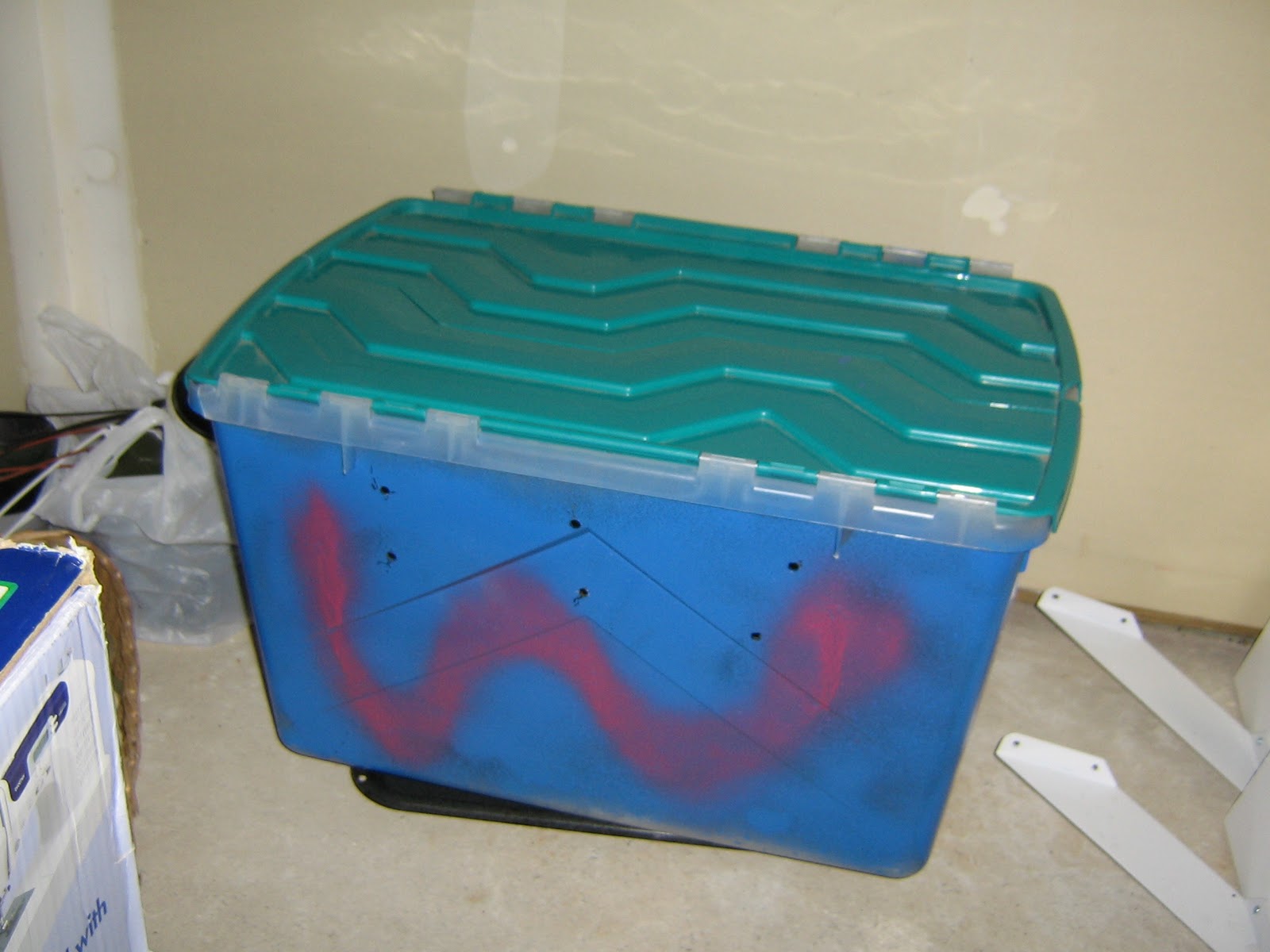
Now that we are in Aloha, we know no farmers, have no green cart, but still eat fruits and veggies!  We also have a little outdoor storage closet... Enter the worm bin.


I found directions about how to set one up here and found fairly local worms here.  I bought my plastic tub at Goodwill for $2.99, and I used our drill to put holes in it for ventilation and draining.  As I was walking home with my container (seriously... who walks 1.7 miles hauling one of these things?  I do.), I remembered that worms don't like light, but I had just bought a clear plastic container.  I remedied this by using some random spray paint that we have.  (For the record, I hate spray paint.  It is full of nasties, as your lungs will attest as you spray it.  From here on out, I'm only buying canned paint and use a brush when we need to paint... preferably the low-VOC variety.)  I happened to have pink, so I painted on a worm.  Or a "W".  Or whatever your imagination says it is.  My wormies arrived in a little box in the mail today, and they were still wriggling, so they're alive.  I prepared their bedding, and I placed them in it, and then I tossed in the few scraps that I managed to save today.

Make worm poop, young pinkish wrigglers!  Then make more worms!  Then I will steal your lovely worm poop and throw it at plants!  It shall be MARVELOUS!

The Oregon Food Bank

Since moving to Aloha, I have found that I have a fair amount of free time and no friends nearby.  To combat both of these issues, one of my thoughts was that I could volunteer somewhere.  I searched on Craigslist for awhile with no great opportunities popping out at me, but this past Saturday I somehow ran across the possibility of volunteering at OFB.  The Beaverton warehouse is about three miles away, so I signed up for a couple of hours today, and I ended up packing a bunch of frozen carrots into family-sized (3 pounds) packages for distribution.  I met a few nice ladies, and we ended up working with a group of students from a high school.  It turned out that in about an hour and a half or so, we prepared about 5,000 pounds of food for distribution which is a lot of food.  I really enjoyed doing this, and when I got home, I signed up for a few more shifts in the coming weeks.

For those of you who don't know much about this organization, it is a private non-profit that does a lot of work to try to prevent Oregonians from going hungry.  OFB is centered in Portland, but, if I remember correctly, the central Portland warehouse works with/feeds into 20 other warehouses across the state, and each of these warehouses works with smaller agencies that actually do the food distribution or cook the food for people to eat (like soup kitchens).  Even better, OFB is genuinely interested in helping prevent hunger, so they run free classes that teach people how to make good food choices to stretch their food dollars farther, how to cook inexpensive and nutritious meals, and how to grow gardens to produce their own food.  A couple blocks from the warehouse that I was working in was a garden that OFB runs, and they use this garden to teach people, and they also use it to create produce (5,000 pounds this year so far as of a few weeks ago) for the food bank.  Additionally, OFB advocates at a legislative level to speak for the hungry and poor in our state.

I really like the idea of doing something to help people be able to feed their families.  I think Jesus had compassion for the hungry, and I want to share in His vision for a world where people are not in need.  It would be very cool if we could all reach out to the people around us who are in need and spread our resources that way, but that is clearly not working, and I think that from my research and experience so far at OFB, it is a great (and perhaps efficient) way to reach out to people in need.  I maybe handled 100-200 bags of carrots today, so I feel like I'm now involved in that many people's lives.

Apparently Oregon is the "second hungriest" state, following Mississippi, I believe, in the nation right now.  The people in our state have been hit very hard by our economy, and OFB is distributing record numbers of emergency food boxes.  From the OFB website, "As a result of growing levels of long-term unemployment, 260,000 people per month eat meals from emergency food boxes. Of those, 85,800 are children. For the first time ever, Oregon Food Bank distributed more than 1 million emergency food boxes in fiscal year 2010-11."  People are hungry!

If you are interested in working with OFB, visit their website.  If you want to find your regional center, you can find that here.  You can also dig around a bit to find local agencies to work with if you want to be a part of actually distributing the food to people.  Of course, OFB takes donations, too.  They accept food donations, and if you find your region's food center, you should be able to either find a list of drop-off sites on their website, or you will be able to find a number to call to ask for this information!  If you want to get more food for your dollar, I'd recommend donating money directly to OFB.  By using their connections and by buying bulk, they can get four pounds of food for a dollar, and that's just impressive.

I think that's all I can think of to say for now, but please let me know if you have any questions!
Tuesday, September 27, 2011

Canned pears


 The pears Matthew and I picked a couple of Saturdays ago finally finished ripening, so I canned 14 quarts of pears today!

The little pumpkin is an upcoming project... Matthew and I both really love pumpkin, and I always bought it in a can.  I finally realized that the canned pumpkin had to come from something I could probably buy.  Indeed, this pumpkin is a pie pumpkin.  I'm going to try using this one, and then I'll probably buy a few of them and freeze some pumpkin this year.  I read the frozen pumpkin is even more delicious than canned... Can you imagine that?


Tuesday, September 20, 2011

Famine in East Africa

I find it appropriate that just after I posted yesterday about having problems finding "the right food" to eat, I learn today that millions in Somalia, Ethiopia, and Kenya are facing a famine.  Perspective!

One blog I follow has a post that talks a little bit about the impacts of the famine, and it also has a suggestion of a campaign taking funds to help relieve the people in East Africa.  In short, crops have failed for a few years, and food has run out for many families.  People are dying quickly, and many more are malnourished so there is concern that the death toll will continue to grow.  If you are so inclined, please feel free to donate to help the people at this page.  I should at least mention on my own post that the money will be distributed to World Vision which is a Christian humanitarian organization that has been helping the people in this area for decades and is stepping up to continue to help during this time of crisis.

If you want to help but you don't find yourself wanting to give to World Vision, this CNN article has more options for people accepting money.  If you can't give money right now, you can certainly pray for the people in need and/or make others who might be able to contribute money know that there is a need for humanitarian aid!  Matthew has a news feed that he follows for news stories, and I don't think that this famine ever showed up, so we didn't know about it.  Perhaps there are others who have not learned about it?

If you want to learn more about the famine, if you Google "famine in Africa" or "famine in Somalia", you will be able to find more news about it.

Thanks for considering these families in need!
Monday, September 19, 2011

Food Woes

So, here's the earth.  Well, at least our little chunk of earth.
One of the things that has been making me kind of stressed out this week is food.  The closest food store to us is Whole Foods which lies about 1.3 miles north of us.  My opinion of Whole Foods is that it's an even snootier Safeway.  The produce isn't particularly local or fresh.  They make a show when a product is "local" (from Oregon), but I read in a book that they pretty much sell all of the same things at each store, and in each store they brag about what's local to that particular store.  They do sell a lot of organic food, though, and I try to remind myself that it's not the worst place to go when needing to get some groceries once or twice a week.

Another food option is New Seasons Market which is local to the Portland area.  The closest market is about 2.5 miles away which is kind of far when one considers hauling groceries.  Perhaps if we get set up to be able to bike and carry things on a bike, this will be more of a regular consideration... However, the market that we went to on Saturday was near to the Beaverton library and Farmers' Market.  It had a slightly more local, co-op feel.  However, I just felt like my trust in their product choices could go only so far when they had Betty Crocker cake mixes and the like.  Truly a relationship breaker, let me tell you.  However, this store has some options that Whole Foods doesn't have (like taring my reused containers so that I can use them in the bulk section), and some of the products tend to be more local since New Seasons is local to the area.  (*EDIT* 10/2/2011:  I had a moment of bravery and asked a cashier at Whole Foods if we could bring in our own containers and get them tared.  It turns out that you can, and he was even super nice and showed me how to do it at any register even if no cashier is there.)

However, the desperation didn't dissipate after visiting these two stores.  For one thing, I use a LOT of wheat flour in my weekly baking escapades.  Whole Foods didn't have whole wheat flour in bulk.  New Seasons did, but it wasn't organic, and it was still $1 per pound which is a lot for non-organic flour.  Neither of these stores had good options for buying non-bulk flour.  Ideally, I'd buy a 25 pound bag of flour.  The stores carried 5 pound bags, and most of the flour has traveled halfway across the country to get here.  Bob's Red Mill is a local option, but it makes my head hurt to think about all of the plastic packaging that they use.  (WHY, Bob's Red Mill, WHY??? Nobody else wraps EVERY product that they create in PLASTIC!!)  I also couldn't figure out a way to buy masa harina without getting it in a plastic bag.

So, today I started considering the option of visiting an actual co-op.  The reason that I wasn't before is because the nearest co-op is about twelve miles away.  Fortunately, I guess, the library is halfway between, so it would actually "only" be an extra twelve mile round trip on the one day every three to four weeks that we would make this journey.  Perhaps that would be worth it to find a place that values buying local, organic food?  We also could become owners and support their cause.  Meanwhile, we could get 10% off discounts on case orders (which I'm hoping would include large bags of flour).  So, that's my current hope, and we'll probably head that way in a couple of weeks.

I also miss having an easily accessible Farmers' Market.  There is one near Whole Foods (about 1.3 miles from us) that runs a short season and ends at the end of August, so we missed it.  The next nearest one is 2.5 miles away right near New Seasons, and it runs Sundays 10am-2pm.  We can go to the Beaverton one when we go to the library, but that'll probably be about every three weeks, and I can't stock up on most types of produce, of course!

Finally, I have been going through "packaging panic" where I can't make seemingly simple decisions because I'm trying to minimize packaging issues.  Here's one example.  I can't figure out what type of milk to buy.  Since we are employed now, I'm trying to switch to buying organic milk products.  I have a few options.  I can buy a plastic gallon milk jug, half gallon paper cartons, or half gallon glass merlons.  The milk in the merlons is from California (while the other two are from Coos County, Oregon), so it has to travel farther and in a heavier (glass) container to get here.  They also have a plastic top that I'd have to throw away, and they are significantly more expensive than the other brands.  The milk jugs and paper cartons are not from as far away, and they are both recyclable.  I am leaning toward getting the paper carton, but I'd happily take advice if you think I'm weighing the factors incorrectly.

Anyway, this has been one of my woes this past week.  Really, my woes have boiled down to food, transportation, and friends/church.  I'll probably blog about the latter two in the near future, too.

Also, thanks for listening to the woes.  I want you to know that I realize I really have nothing to complain about because I am fully blessed just to have the food that I need to sustain me.  However, if you know me very well at all, you probably know that if I choose to address a problem, I can't help but to throw myself at it and give it everything I have, and that's simply what I'm doing here.  I'll figure out a system in the end, but it's very different from the system I created in Corvallis, and it's just taking me time because I'm just that picky!  : )


Saturday, September 3, 2011

Canning tomatoes!

I canned for the first time today!!!  How exciting!  I canned tomatoes because we use crushed tomatoes fairly often, and I found a u-pick place in Corvallis.  Its website is here if you're in the Corvallis area and interested in getting some tomatoes.  We got about 58 pounds for $35, and it was really fun!  The tomato plants just sprawl on the ground, so it's like an Easter egg hunt when looking for the ripe, red tomatoes.  If you are interested in canning, I recommend the Tattler canning lids that we got because they are reusable and BPA free.  Anyway, I'm just kind of exciting about canning the first time.  It's really cool to pick our own food at a local farm and then store it away so that we can eat it over the winter.

Enjoy the pictures!

58 pounds of tomatoes

Part of my fleet of canning jars.  I only used 14 today.

Making a mess...

It's a pumpkin tomato!

Simmering away...

The 14 quarts of deliciousness...


Thursday, August 11, 2011

How to make vegetable broth...

... because it's really ridiculously simple.

1) Save vegetable scraps.  Freeze them if you need to!  (I did...)  I used bits of potato, carrot tops, onion skins, zucchini tops, bits of brocolli stalks, garlic tops and skins, and probably some other things that I'm not remembering.  I also tossed in some fresh oregano that I have growing, and I added some pepper and a couple of bay leaves.  You can look up other vegetables to see if they go in broth if you are uncertain.  The only thing that I know you don't want to add is leafy greens like lettuce, spinach, and kale.

2) When your bag is full, get ready for broth time!  Defrost your veggies and throw them in a stock pot then add some cold water.  (Apparently, it's somehow better if you start with cold water.  Vegetable magic, I'm sure.)  Theoretically you are supposed to have about one parts water to one part vegetable matter.  I'm pretty sure you'll be OK as long as you have a decent amount of vegetable matter.

Nom nom nom... Looks delish!

3) Now turn up the heat, and get this pot of goodness simmering!  You don't really want it to boil, but you do want it to simmer.  Once it's simmering, put it on a heat that will keep it simmering, and let it go for at least an hour!  I stirred mine every once in awhile, but that might not be totally necessary... I might have just wanted to admire my broth.

4) After around an hour, your kitchen probably smells great, and your broth is also probably done.  It's time to strain out the squishy plant matter and save the broth.  Remember, this isn't pasta... you want to save the liquid and get rid of the solid stuff!  (I only say this because this part of the process felt incredibly backward to the pasta-eater in me.)  Set your strainer in a bowl or another pot, and pour your liquid in.

It looks delicious and nutritious!

5) Let your broth cool off, and then store it in containers to freeze or use.  I used some cottage cheese containers that I've collected over the year.

My almost full gallon bag of veggies gave me about 12 cups of broth, I think.  I already used two cups when making rice yesterday, and it added a nice flavor (and probably some nutrients!).

So there you have it!  A very inexpensive, resourceful way to have some broth around.  Enjoy!
Saturday, July 30, 2011

Today's produce is brought to you by the color GREEN!


We went to the Farmer's Market this morning, but we didn't have a ton to get since we just went on Wednesday.  However, what we did get was so pretty that I thought you might want to see it!  See?  Pretty greens!

If you are thinking that that is a lot of zucchini, then you are right!  Those are ten large organic zucchinis that we got for 75 cents each.  After a little bit of time in the kitchen, I have 24 cups of grated zucchini stored in a bunch of cottage cheese containers that we are reusing.  I will use two in a pasta salad, and the rest will go into the freezer to be made into zucchini bread and zucchini brownies this winter when local produce is not as abundant.  YUM!
Thursday, July 28, 2011

More on Food

This year I have read a few books  about the agricultural and food system in our country including Fast Food Nation, Food Inc., and Recipe for America.  With every book I read, I become more passionate about our country's food system.  Here are some of the ideas in my head after absorbing all of this information:


  • The food people eat is causing them to be sick instead of healthy.
  • The method that food is grown and produced is harmful to people, animals and the planet in general.
    • The chemicals used as fertilizers, pesticides, and herbicides are not good for human consumption.
    • Conventional (as opposed to traditional/organic) farming methods deplete the soil of nutrients which causes food to have fewer nutrients.
    • Cow are not being fed the right types of food for their digestive system which makes them live their whole lives in pain and battling sickness.
    • Animals are generally kept in small cages that literally drives them insane.  Chickens are debeaked to keep them from attacking themselves or other chickens.
    • Animals are slaughtered in a brutal method.  Many cows are skinned alive.  Many chickens are scalded while still alive.  This also endangers the humans who are skinning a cow that is kicking at them.  Plus, it seems like this would be a mentally damaging incident as well.
    • Factory and farm safety conditions are not well-regulated, and if they are regulated, there is often little accountability.
    • Animal waste from factory farms is not managed, and it winds up in the water supply which can cause issues.
    • All of the dangerous chemicals used on plants can (and do) end up in the waterways.
    • The methods used to grow food (like chemicals), raise animals (like feeding cattle corn-based diets which increases E. coli risks greatly), and prepare food (like in the slaughter house where workers work at a feverish pace which increases the chances of contaminating meat with fecal matter and therefore E. coli) are creating health risks and problems.
    • Not the fisherman's fault, but many fish are high in bad stuff like mercury.  I used to think that this was just normal for fish composition, but I just recently learned that it is because of human waste that has caused mercury to end up in the waterways and thus the water animals.  Additionally, though, we are overfishing which is kind of bad news.
    • Many farms and meat packers hire illegal immigrants which makes for cheap, abusive labor situations sometimes to the point of slavery.  
  • Our system is not making is easier for people to eat well.
    • Subsidies are poorly distributed, and so there is overproduction of many grains.
    • The most cost-effective thing for people to eat is generally processed corn or wheat.
    • Fresh foods are not available in many neighborhoods... especially in non-wealthy neighborhoods.
  • Our system is making it difficult for small farms to remain viable.
    • Big business (*cough* Monsanto *cough*) is making it hard for some small, local farmers to continue to exist.  Monsanto has been known to sue the bejeebers out of a farm that has Monsanto GMOs (genetically modified organisms) on their farm without buying the seeds from Monsanto.  The problem is that the farmers don't even want the GMOs.  Rather, the seeds are blowing onto their land from nearby farms.
    • Certain laws can make it challenging for a small farm to afford to exist.  For example, if tracking cows becomes required (to be able to trace E. coli outbreaks), some small farms will not be able to afford to satisfy this requirement.  Unfortunately, it is not generally the small farms that cause E. coli outbreaks.
I described last September how Matthew and I have changed our eating habits for our health, the health, safety and fair treatment of workers, the planet's health, and many other reasons.  We have continued on a $300 per month budget throughout the year, and we've had success.  We've also made some positive changes, I think.  We no longer buy any produce from Fred Meyer, and we now buy all of our produce from the co-op and the Farmer's Market or directly from the farm!  Our meat consumption has dwindled down to next to nothing since we buy maybe a pound of meat every 3 months.  We did this in part because good meat  is fairly expensive but also because we found that we were enjoying the vegetarian meals greatly.  I have made yogurt all year which is less expensive and uses less plastic.  As an added benefit to all of these changes (plus biking/walking more and driving less), I, without even trying, lost about ten pounds and got down to the weight that I was when I graduated from high school six years ago.  Not too bad for an almost 24-year-old woman! ;)

If you find that you are also upset by the food most stores have to offer, you are welcome to do something too!  I've worked my way up to being fairly "extreme", and I understand that.  There are a lot of different things you can do to change what you eat and help build a healthy food system.  Here are some ideas, if you are interested:
  • Make one change at a time as you feel moved to do so.
  • Create a food budget, and budget some of that money specifically to organic food, a co-op, or a farmer's market.
  • Consider going to a farm and u-picking and preserving (freezing, canning, drying...) food!
  • Consider eating less or no meat and buying any meat from a local provider or a provider that you know uses good methods.
  • Know what you are eating.  Where did it come from?  What state?  What farm?  What practices are they using?  Is a big business involved?  (Sorry, Big Business, but you are often unethical...)
  • Consider preparing more of your own food instead of buying convenience foods.  It will save money so that you can afford to buy better foods.  Plus, you are more likely to know what's going into your meal which is always a good thing.
  • Buy BULK!  It's so much cheaper than buying packaged food!  Spices are phenomenally cheaper, and most other food prices can't be beat either.  This will again save you money for some good quality food!
  • Don't be tricked by cheap food prices.... Remember that there is a reason that it is cheap.  It's either probably not really healthy and/or someone or something was damaged or abused to make your food cheap.
  • Really, make one change at a time as you feel moved to do so.  This process was really enjoyable for us, and it can be for you too.  It has been a relief to finally react to the facts that I had tucked in the darkest corners of my mind.  Let yourself be moved by the facts that you find, and just do the best that you can! :)
There are places to go to get involved politically like the Organic Consumer's Association, Food and Water Watch, Consumers Union, and Food Democracy Now.  Also, some food blogs include La Vida Locavore, Food Politics, and U.S. Food Policy.  These are some of the resources given by Jill Richardson in Recipe for America, and I have not had a chance to look through all of them yet, so I am not quite sure what they all involve!

Thanks for letting me ramble a little bit more about food!  Feel free to leave comments if you have something to say or any questions!


Saturday, June 18, 2011

More food adventures

I discovered fava beans today at the Farmers' Markets.  Who can say no to an adventure with giant, five or six inch long beans?  Not I!  We ate them with lunch today after sauteing them in olive oil with a clove of garlic.  While it didn't become an immediate favorite, it was certainly good!  Eating a ginormous bean has an element of fun, too!
 

Blog Template by BloggerCandy.com