Showing posts with label environmental issues. Show all posts
Sunday, March 25, 2012

Mowing the lawn the old-fashioned way


Have you seen one of these before?  I only have seen a couple in my life.  It's a push reel mower.  You push it, the blades spin, and the grass gets cut.  Simple, no?  We got this mower off of Craigslist for $60, and we will never ever have to buy gas for it!  Lawn mowers are notoriously bad polluters because there are fewer regulations for lawnmowers than for cars.  For our 0.21 acre lot, it works just fine!

As an added bonus, it is amazing exercise.  It was pretty challenging the first time, actually.  That might be because I painted, packed, cleaned, and moved on Wednesday, Thursday, Friday, and Saturday.  It also might be because the lawn really should have been mowed a few weeks ago so it was kind of long in a few areas.  It got done though!

Happy Spring to everybody!  May your lawn mowing be equally fulfilling!
Wednesday, February 15, 2012

Electronics: They come from where?

Note:  Before reading this post, I want to disclose the fact that after I wrote this post I found out that Dr. Daisey perhaps used some creative license to share the information he gave.  It's not that the information about the working conditions is necessarily false, but, from what I can tell, he essentially is telling some true stories and some made-up stories that he believes honestly represents true situations.  The information he gives matches with other sources that I have read, so I still think it is still worth thinking about.  However, I do wish that he hadn't been somewhat "deceptive" in how he delivered the information.

A couple of my friends linked to Mr. Daisey and The Apple Factory on Facebook recently, and one friend asked if I had heard it and said:
"Maybe you could do a blog post about "good" vs. "bad" companies: are there any that are responsible third-world employers? What does that even mean? Which major (tech) manufacturers don't use third-world labor?"
Well, I had not yet listened to the radio show, but I had heard of Foxconn and their policies.  However, I am going to go ahead and listen to the show (which is about an hour long), and I will make notes as I go in case you don't have an hour to listen to such things.  I am taking notes quickly, so let me know if you thing I mistyped something that was said.  The notes are in purple, so you can skip them if you just want to see the punchline at the end: I will tell you my findings about "good" and "bad" companies and third-world labor.

  • Daisey loves his electronics, but he points out that he rarely thinks about how things are made.  He says that he sort of assumed that robots made them.  However, he learned that humans are involved in the process, and then he started to think.
  • Shenzhen (a city of over 8 million people) is the place in China where almost all our "crap" comes from, yet most of us don't know it's name.  We know the stuff's from China, but we don't realize it usually comes from one specific city.  Corporations made a deal with the Chinese to help create a modern China.  Shenzhen is part of this deal.
  • Daisey plans to go to Foxconn which is a company that makes electronics for Apple, Dell, Samsung, Nokia, etc.  He plans to stand at the main gate and talk to anybody who wants to talk to him.  Journalists in Hong Kong tell him it's a bad idea, but he can't get any information through the normal channels.  
    • When he got there, he saw that the plant is enormous - 430,000 workers.  There are more than 20 cafeterias at the plant each one holding up to 10,000 people.  (Try to visualize that!)  There are guards at the gate who look "really pissed", and they carry guns.  
    • Recently a journalist had been beaten for taking pictures near the Foxconn building.
    • Daisey was there right after the successive suicides at Foxconn.  The nets to catch the suicidal people have been put into place.
    • A huge line of people show up to talk to him!  They want to tell him the stories of their lives and workplace.
      • One lady cleans the screens of I-phones.  She's 13 years old.  Some of her friends have jobs at Foxconn too.  Foxconn doesn't check ages.  During an inspection, Foxconn puts the oldest workers on the inspected line.
  • Can Apple not know?  A company obsessed with the details?  Or are they just doing what we're all doing?  Do they seek what they want to see?
  • His next plan was to visit a bunch of factories, pretend to be a businessman, and pretend to want to buy whatever factories are selling.
    • Each factory had gates and guards.  Then big green lawns and huge lobbies.  The executives come down "in a gaggle" and escort you to a conference room.  Then they show you the factory floor.  The floors are silent.  Nobody is allowed to speak on the line.  The only sound is  bodies moving constantly.
    • Anything that can be made by hand is made by hand because the cost of labor is effectively zero.
    • The people he talked to worked 12 hour shifts standard, but often much longer than that.  When a "hot new gadget" is coming out, they might work 16 hours or more a day for months.  While he's in the country, a Foxconn worker died after working a 34-hour shift.  That's not the only case of that happening.
    • Dormitories are cement cubes.  About 12'x12' with 13-15 beds.  There are cameras in the rooms and hallways.
  • The way Daisey sees everything is starting to change.
  • He notices that things are still "handmade", just not in the way that we always wish things were handmade.
  • Runs through his head: "Paranoia is not paranoia if they're actually out to get you."  He goes to a restaurant to meet with a union interested in labor reform.  These are secret because you can go to prison for years for being involved with one of these unions.  He wants to hear what they have to say.
    • There is turmoil is Southern China.  They helped organize a strike in Honda factories.
    • n-hexane is used to clean screens, and it's a known neurotoxin.
    • Peoples' joints have disintegrated by the time they are 26 of 27 from doing the same motion over and over and over.  Then they are fired.
    • If you talk to the labor board about problems, you get put on the black list and you get fired.
    • The workers usually never get to see the final product on.  A worker said, "It's a kind of magic," when he got to see an I-pad working.
  • His partner (Kathy, a Chinese translator) wonders if they are mentally ill.  "Are they making it up?"  Daisey's answer, "What do you think?"   Kathy says, "No... It's just, you hear stories, but you do not think it is going to be so much, you know?  It's just so much."
The following is the host's responses and further exploration (I didn't do a terrific job with this section, sorry):  
  • The host did their best to fact check everything from the excerpt.  The host tried to get Apple and Foxconn to respond, but they refused.
    • Only one real objection from Ian Spaulding, founder and managing director of INFACT Global Partners, which goes into Chinese factories and helps them meet social responsibility standards set by Western companies:  There is child labor in China, but not in top-tier electronics factories.  Daisey continues to claim that he met the workers.  Not many, but some.
      • Apple found 91 under-aged workers in an audit of it's own factories.  It helped the kids get back in school, and ended working with one supplier.
  •  SACOM, Students and Scholars Against Corporate Misbehavior, based in Hong Kong claims:
    • The workers are forced to stand to improve productivity
  • 10-20% overturn of workers every month
    • Workers leaving forces factories to make some improvements
  • Apples claims they are 100% transparent, but they refuse to come to the air
    • They have a code of conduct the suppliers must comply with, and Apple conducts audits
    • If audits don't go well, Apple claims to end work with supplier
    • Apple asks suppliers not to use n-hexane
  • Daisey is happy they do some things, but he is concerned that even in Apple's own reports, things aren't good.  He thinks companies need to be held responsible, but they won't provide supplier names so that people can independently check up on things.
  • The question is, "Should we feel weird about buying these things made faraway?"
    • Many say no.  Sometimes the factories are an improvement from other possibilities (including poverty).
    • People say that the factories provide employment opportunities in China, especially for young women.  It takes people from the grimness of rice paddies to the grimness of Foxconn.
    • Sweatshops are bad, but they help fight poverty.
    • "Sweatshops are a phase countries go through."
  • Daisey just wants basic worker protection.  Rotate people in jobs in factories.  Inspect without announcement.
    • We fought for these things in our country to protect people.  Then we just shipped the jobs to other countries to treat other people as poorly.
"Out of sight, out of mind..."


First of all, the ethics of electronics goes way beyond the serious labor issues.  I just read The Story of Stuff recently, and I learned a lot about electronics.  (I highly recommend that book, by the way!)  The ethical issues begin with sourcing of materials which often damages natural resources in other countries and even forces people off of their land, and the issues end with the fact that electronics are often sent to China at the end of their lifetimes where they are recycled by workers who are not properly equipped to be dealing with the toxins and other nasties that the electronics are filled with.  From beginning to end, and all the way throughout the process, the manufacturing of electronics is a messy process that maybe should probably turn some heads.

Now back to the original concern.  I am similar to Daisey in that I think that we should care that people are not being treated well as they make all of our "crap".  However, in my research, it is really hard to label any company as "good" or "bad".  I have read that HP does a fair amount to try to be "good", but even HP is not close to perfect when it comes to helping the environment or people.

So what should we buy?  There is no black-or-white answer here!  However, first of all, buying used or refurbished is probably best for the environment and people.  Additionally, buying fewer electronic gadgets in general is an option.  If you are going to buy something new, though, you might want to check it out on the Good Guide which is an amazing site (recommended by the author of The Story of Stuff, Annie Leonard).  You can get the Good Guide to rank potential purchases by different issues (environment, society, health, etc).

Other sites that I found interesting:


Good luck to all of you who are interested in being an ethical consumer!  It's not always clear what the best decision is, I don't think, but I personally think that if we choose to work to improve things, things will get better.  At the very least, let's not have the "out of sight, out of mind" mentality anymore.  Let's keep this in the open and keep discussing things because we want to make the world better for everyone.  Additionally, feel free to contact companies when you question their values.  Let them know if you choose another company over theirs because companies will respond to consumer pressure.

Monday, December 12, 2011

The Obsession with "New"

In my experience, when there is a drive for toys, clothes, etc. to help families, there is often a mandate that donations be new items.  I understand that it is not as sacrificial or desirable to give someone else your worn out clothing or half-broken toys.  I also understand that people are requiring this out of a good heart because they feel like since they don't give used gifts to their own families and friends, why should other families have to get used gifts?

It's just that I think the question should be, "Why shouldn't I give already-been-loved gifts to my family and friends?"  The answer in our household is, "No reason.  Do it."

For this reason, it actually becomes a very odd experience to want to give items to people in need and to be told that I have to buy new items.  Here are some thoughts that end up going through my head:

"I rarely buy anything new... period."

"We can't always all have new things.  There is so much stuff already floating around needing a good home to use it up.  By always demanding new, we are effectively taking away at least some of ability for future generations to have the resources and ability to make their own new products."

"If I am buying something new, I feel led to research my item to buy something that was made in a way that tried to avoid harming the environment and did not exploit human workers."

"New things cost a lot.  If a family needs hand towels, why can't I buy a few adorable, gently-used towels at a thrift shop for way less money?  Then I can use the rest of the money to do more to help people out."

I love that people want to meet others' real needs, and if you have ever done so then awesome!  If done out of compassion and generosity, then your good heart is admirable.  I'm just saying: Here's for creating a culture that views used goods as valuable and equally awesome instead of "cheap" and of poor taste.  After all, I'm not too good for something someone else no longer wanted/needed... Are you?
Saturday, December 10, 2011

Solar Lighting

While solar lighting doesn't make a lot of sense to me right now as I look outside at a gray, cloudy day, it does make all kinds of sense to people in sub-Saharan Africa.  This post talks about how much sense it makes when compared to the alternative -- often kerosene.  It also make sense because it can free up a significant portion of a person's income!

In case the term "solar light" is new to you, the light is simply a lamp that contains a rechargeable battery and is charged by a photovoltaic panel (like those you see on roofs, only little).

After considering the list of projects, Matthew and I found Solar Sister to be the one that most caught our attention (although there are a lot of other wonderful projects...)  What appealed to us was the fact that a donation would provide the means for a woman to gain income through the sales of these solar lights.  It reminded us of Kiva.  (Speaking of which, have you set up an account at www.kiva.org yet?  Because it's awesome.  Seriously.)
Friday, December 2, 2011

What's going on out there...

I've been reading and listening to some interesting things this week, so I thought I'd share some of them here.

First up is an article about how large multinational corporations are marketing their junk food products to new people... the poor and malnourished around the world.  It really does bother me that corporations are willing to grow at the expense of the health and well-being of people.  Want to know what you can do to help?  My personal method is to do my best to avoid products from large companies unless I figure out that they're a good company.  Every time I spend money, I view it as a vote in my mostly capitalistic economy.  If you want something else to do, I think that it might also be good to write to corporations to let them know how you feel and why you will not buy their product.

The next article discusses the future of global warming and some geoengineering ideas of how to combat it.  It really scares me to have humans try to play with the atmosphere, clouds, etc to try to affect our climate.  I totally understand why they are considering these ideas, and I respect them for acknowledging that this would be a last ditch attempt to buy more time for humanity to stop destroying our home (you know, Earth), but I think that such a large-scale action that cannot really be tested in advance could also be devastating.  The idea of temperatures rising 11.5 degrees Fahrenheit over the next 90 years is overwhelming, too.  I know I will only be around so long, but I'd really like for my children and grandchildren to be able to live a peaceful life and enjoy our beautiful planet.  (To Christians who believe that Jesus will return and make it all better before any of this happens, I must say this:  You don't know that.  We have no guarantee that we won't destroy much of our population in the years to come.  God loves us, but He certainly is not obligated to miraculously save us from our own selfish actions, right?)  Want to know what you can do?  Take some time to learn about what's going on.  Be willing to change yourself.  Be willing to speak out at the political level.  Again, vote with your money.  Learn to live differently, and pray that your life will positively affect others.

Up next is a video of a young man speaking about how he was raised by a lesbian couple.  When I was adamantly against the legalization of gay marriage, I was asked why it mattered if a homosexual couple had the same legal rights as a heterosexual couple.  The reason that I was taught to give was that adopted babies wouldn't be given as good of a home to live in.  Now I just don't think this argument is fair, and I don't think it should be used.  I do think that children should having loving relationships with both men and women (opinion, not fact), but I think that a homosexual couple could ensure that this happens through extended family, church family, and other groups.  I know that not everybody out there agrees with me, and I think that everybody has the right to their own opinion, and they should vote for what they believe is right.  I just encourage people to think about their decision and be open to listening to God even if it might mean changing.  At this point in my life, I feel strongly that I need to support homosexual couples in their endeavor to be accepted in society.  I tend to believe that in 100 (or fewer) years, people will look back and view the efforts to prevent gay marriage similarly to how most of us view the efforts to prevent interracial marriage (which was also justified using the Bible).

Speaking of interracial marriage... Here we have an example of a church who still struggles to accept that it is truly alright.  If this isn't a humbling example of why we should keep our heart open to change, I don't know what is.  What comes to mind is: Live justly, love mercy, and walk humbly with God...  (Micah 6:8 for those of you who are amazed that I'd come up with something so lovely on my own... I didn't!)

I will leave you with a really neat story about a man who, to me, seemed to follow the teachings and show the love of Jesus.  I have no clue whether or not the man was intending to do so, but my heart tells me that God was in the details.


Tuesday, October 4, 2011

WORMS!

I've been thinking about worms for a long time...

Most of Matthew and my waste these days comes from the leftovers from our produce; rinds, cores, and the like.  I know it seems like this is innocuous stuff to send to the landfill because it's totally biodegradable, but unfortunately it's not.  In short, the conditions in a landfill are not those such that food waste can biodegrade.  (For more information about this, you can read about it here and here.)  What's worse is that because the waste is in an anaerobic environment, it ends up producing a lot of methane which is a major greenhouse gas that is 21 times more potent than carbon dioxide.  (Which is another reason to consider eating less beef, since cows are amazing methane producers, but I digress...)

In Corvallis, we did our best to keep our food waste from going to the landfill by hauling most of each week's scraps to church on Sunday and handing them off to a family who owns goats and chickens who eat said scraps.  If you happen to live in Corvallis, you might be interested in their municipal compost heap.  They have "green carts" that you can put in all kinds of plant and food matter along with paper towels and certain paper plates/cups.  (You have to verify that the plates/cups that you use do not have a plastic coating on them which many of them do... You may think it's wax, but it's probably plastic.  Look for plates that say they are compostable, or contact the manufacturer and ask them what the coating is.  Or, better yet, just use reusable plates.)    We were unable to participate in this awesome program, though, because we lived in an apartment that didn't have a bin.  I considered asking our manager to get one, but I realized that based on what I found in the recycling bins, I didn't think that the people in our apartment would use the green cart properly.  I digress yet again...

Now that we are in Aloha, we know no farmers, have no green cart, but still eat fruits and veggies!  We also have a little outdoor storage closet... Enter the worm bin.


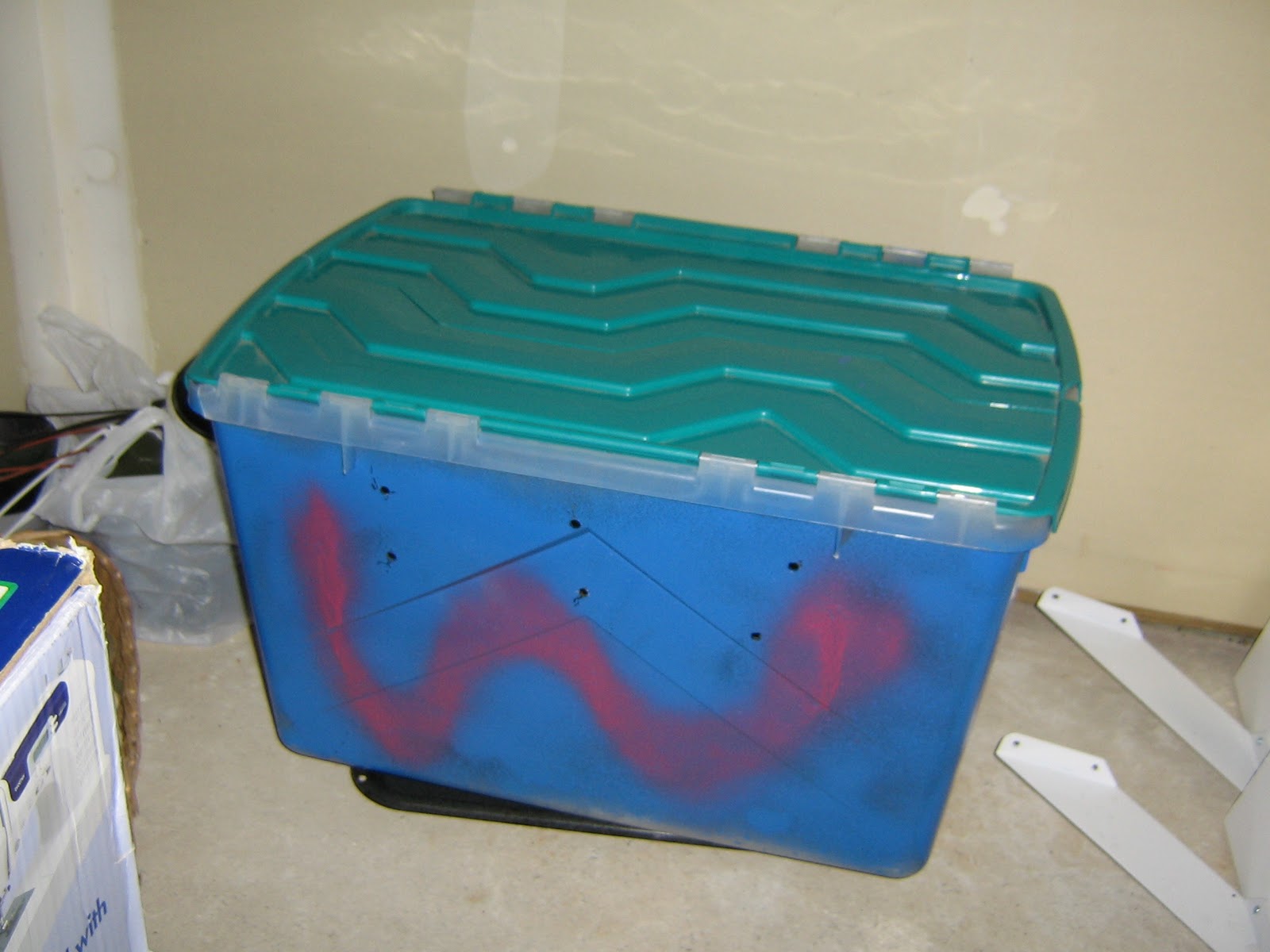
I found directions about how to set one up here and found fairly local worms here.  I bought my plastic tub at Goodwill for $2.99, and I used our drill to put holes in it for ventilation and draining.  As I was walking home with my container (seriously... who walks 1.7 miles hauling one of these things?  I do.), I remembered that worms don't like light, but I had just bought a clear plastic container.  I remedied this by using some random spray paint that we have.  (For the record, I hate spray paint.  It is full of nasties, as your lungs will attest as you spray it.  From here on out, I'm only buying canned paint and use a brush when we need to paint... preferably the low-VOC variety.)  I happened to have pink, so I painted on a worm.  Or a "W".  Or whatever your imagination says it is.  My wormies arrived in a little box in the mail today, and they were still wriggling, so they're alive.  I prepared their bedding, and I placed them in it, and then I tossed in the few scraps that I managed to save today.

Make worm poop, young pinkish wrigglers!  Then make more worms!  Then I will steal your lovely worm poop and throw it at plants!  It shall be MARVELOUS!
Monday, September 26, 2011

Rethinking laundry

Part of what has come with this move is rethinking all of our old solutions to "problems".   As we took steps to become a more simple, sustainable home, we had to consider how we would do things that would work in our apartment.  Well, we have a new apartment now, and it's time to solve all of the same problems... again!

In our old apartment, I'd wash a load of laundry in a common washing room, and then I'd haul it out to the balcony and hang it on our wooden laundry rack and our clothesline.  Once the days stayed below the 60s, I would use the dryer again.  Our apartment stayed cool, and in the Pacific Northwest you just can't leave damp things around in the winter!

Upon arriving at this apartment, we noticed that one of the rules is that we are not supposed to put laundry on our patio (any at all, I am assuming).  I quickly realized that the clothesline is going to take an extended vacation, and I started drying our clothes on the drying rack inside in front of the sliding glass door where there is a fair amount of light.  However, a full large load of clothes doesn't fit on the drying rack, and the clothes just don't dry as quickly inside, so they sometimes smelled a bit sour.  That's just not going to work for me.

Fortunately, we have our own washer and dryer, so I can be a bit more flexible about their use since it isn't a flat rate of $1.00 any time you want to turn the thing on.  I also decided to break the rules.  I'm putting the drying rack outdoors whenever it is warm and dry enough.  I am sticking it in the back corner, and I'm placing our outdoor chairs in front of it, so I am hoping that nobody even notices it.  If the management says something,  I'll bring it back indoors.  I'm also considering writing to the property management company to suggest that they rethink their rule and perhaps at least allow drying racks although I'd understand if they don't want clotheslines or clothing on railings.  Must.... fight... ridiculous rules....

Anyway, about being flexible with washer and dryer use...  I used to do absolutely full washer loads because I read somewhere that the motor used to run the washer worked just about as hard for a medium or small load as for a large load.  I haven't been able to find that again, and I'm not even sure it's true; however, that was my working assumption.  Here, if I do a large load there is just no way to dry it without using a dryer.  I figure that the dryer is more of an energy hog, so I have started doing medium loads.  This size of load fits on the laundry rack, and I can (sneakily) dry it outside if it's warm enough.

For all of the frustrations and backward stepping here, I have found a way that this whole thing might actually break even or come ahead energy and possibly even money-wise.  Since I can run the dryer for as short of a time as I'd like, I've decided to employ a "finishing it off" method to drying.  Unless somebody complains, I think I can continue to dry clothes completely outside during the summer.  However, now when it's cold, I plan to wash clothes in the morning, let them hang dry in front of the glass door until early evening, and then finish them off in the dryer using as little time as they need.  Sound good?
Thursday, July 28, 2011

More on Food

This year I have read a few books  about the agricultural and food system in our country including Fast Food Nation, Food Inc., and Recipe for America.  With every book I read, I become more passionate about our country's food system.  Here are some of the ideas in my head after absorbing all of this information:


  • The food people eat is causing them to be sick instead of healthy.
  • The method that food is grown and produced is harmful to people, animals and the planet in general.
    • The chemicals used as fertilizers, pesticides, and herbicides are not good for human consumption.
    • Conventional (as opposed to traditional/organic) farming methods deplete the soil of nutrients which causes food to have fewer nutrients.
    • Cow are not being fed the right types of food for their digestive system which makes them live their whole lives in pain and battling sickness.
    • Animals are generally kept in small cages that literally drives them insane.  Chickens are debeaked to keep them from attacking themselves or other chickens.
    • Animals are slaughtered in a brutal method.  Many cows are skinned alive.  Many chickens are scalded while still alive.  This also endangers the humans who are skinning a cow that is kicking at them.  Plus, it seems like this would be a mentally damaging incident as well.
    • Factory and farm safety conditions are not well-regulated, and if they are regulated, there is often little accountability.
    • Animal waste from factory farms is not managed, and it winds up in the water supply which can cause issues.
    • All of the dangerous chemicals used on plants can (and do) end up in the waterways.
    • The methods used to grow food (like chemicals), raise animals (like feeding cattle corn-based diets which increases E. coli risks greatly), and prepare food (like in the slaughter house where workers work at a feverish pace which increases the chances of contaminating meat with fecal matter and therefore E. coli) are creating health risks and problems.
    • Not the fisherman's fault, but many fish are high in bad stuff like mercury.  I used to think that this was just normal for fish composition, but I just recently learned that it is because of human waste that has caused mercury to end up in the waterways and thus the water animals.  Additionally, though, we are overfishing which is kind of bad news.
    • Many farms and meat packers hire illegal immigrants which makes for cheap, abusive labor situations sometimes to the point of slavery.  
  • Our system is not making is easier for people to eat well.
    • Subsidies are poorly distributed, and so there is overproduction of many grains.
    • The most cost-effective thing for people to eat is generally processed corn or wheat.
    • Fresh foods are not available in many neighborhoods... especially in non-wealthy neighborhoods.
  • Our system is making it difficult for small farms to remain viable.
    • Big business (*cough* Monsanto *cough*) is making it hard for some small, local farmers to continue to exist.  Monsanto has been known to sue the bejeebers out of a farm that has Monsanto GMOs (genetically modified organisms) on their farm without buying the seeds from Monsanto.  The problem is that the farmers don't even want the GMOs.  Rather, the seeds are blowing onto their land from nearby farms.
    • Certain laws can make it challenging for a small farm to afford to exist.  For example, if tracking cows becomes required (to be able to trace E. coli outbreaks), some small farms will not be able to afford to satisfy this requirement.  Unfortunately, it is not generally the small farms that cause E. coli outbreaks.
I described last September how Matthew and I have changed our eating habits for our health, the health, safety and fair treatment of workers, the planet's health, and many other reasons.  We have continued on a $300 per month budget throughout the year, and we've had success.  We've also made some positive changes, I think.  We no longer buy any produce from Fred Meyer, and we now buy all of our produce from the co-op and the Farmer's Market or directly from the farm!  Our meat consumption has dwindled down to next to nothing since we buy maybe a pound of meat every 3 months.  We did this in part because good meat  is fairly expensive but also because we found that we were enjoying the vegetarian meals greatly.  I have made yogurt all year which is less expensive and uses less plastic.  As an added benefit to all of these changes (plus biking/walking more and driving less), I, without even trying, lost about ten pounds and got down to the weight that I was when I graduated from high school six years ago.  Not too bad for an almost 24-year-old woman! ;)

If you find that you are also upset by the food most stores have to offer, you are welcome to do something too!  I've worked my way up to being fairly "extreme", and I understand that.  There are a lot of different things you can do to change what you eat and help build a healthy food system.  Here are some ideas, if you are interested:
  • Make one change at a time as you feel moved to do so.
  • Create a food budget, and budget some of that money specifically to organic food, a co-op, or a farmer's market.
  • Consider going to a farm and u-picking and preserving (freezing, canning, drying...) food!
  • Consider eating less or no meat and buying any meat from a local provider or a provider that you know uses good methods.
  • Know what you are eating.  Where did it come from?  What state?  What farm?  What practices are they using?  Is a big business involved?  (Sorry, Big Business, but you are often unethical...)
  • Consider preparing more of your own food instead of buying convenience foods.  It will save money so that you can afford to buy better foods.  Plus, you are more likely to know what's going into your meal which is always a good thing.
  • Buy BULK!  It's so much cheaper than buying packaged food!  Spices are phenomenally cheaper, and most other food prices can't be beat either.  This will again save you money for some good quality food!
  • Don't be tricked by cheap food prices.... Remember that there is a reason that it is cheap.  It's either probably not really healthy and/or someone or something was damaged or abused to make your food cheap.
  • Really, make one change at a time as you feel moved to do so.  This process was really enjoyable for us, and it can be for you too.  It has been a relief to finally react to the facts that I had tucked in the darkest corners of my mind.  Let yourself be moved by the facts that you find, and just do the best that you can! :)
There are places to go to get involved politically like the Organic Consumer's Association, Food and Water Watch, Consumers Union, and Food Democracy Now.  Also, some food blogs include La Vida Locavore, Food Politics, and U.S. Food Policy.  These are some of the resources given by Jill Richardson in Recipe for America, and I have not had a chance to look through all of them yet, so I am not quite sure what they all involve!

Thanks for letting me ramble a little bit more about food!  Feel free to leave comments if you have something to say or any questions!


Wednesday, July 6, 2011

The Virtuous Consumer

I just finished The Virtuous Consumer by Leslie Garrett, and I think that it is a book worth reading if you are interested in reconsidering some or all of your consumer decisions.  Garrett does a good job of laying out all sorts of options for dealing with decisions about clothing, kids, houses, decorating, celebrating holidays, food, beauty products, and more.  If you are looking for someone who offers fairly moderate ways to change, I'd highly recommend this book!

I don't blow my nose on trees anymore...

Why?  Maybe because I like hugging them.


Actually, that's not the reason.  Although, hugging that tree would have been a lot more gross if someone had blown their nose on it.

Honestly, I can't keep up with the politics of tissue making.  I know that Kimberly-Clark (the makers of Kleenex) has gotten a lot of flack about their practices.  I think they were chopping trees down in an unsustainable manner and in a way that was harming habitats and such.  Regardless, even if we find a good way to source the trees, there is still a water-wasting, energy-intensive, chemical-filled process that turns a chunk of brown wood into a fluffy, bright white cloud for your nose.

I avoid keeping up with the politics and the chemicals by avoiding tissues altogether.  I have been struck down by a ridiculous head cold these last few days (the kid who gave it to me might have gotten extra homework when I tutored him yesterday...), and I have been blowing my nose on cloth.  I have used a few handkerchiefs that I used to use to pull my hair back during middle school when it was still fashionable (I think?).  I also made a stack of handkerchiefs out of the scraps of the sheet that I used to make drawstring bags.  Finally, I have even been using a small stack of real, bona fide frilly hankies that I got my hands out.  Nothing is too good for my nose goo.  Except maybe trees.

To rinse them out, I leave them in the sink for a while and we wash our hands over them.  Then they are ready to go in the laundry, get cleaned, dry in the sun, and then be used again!

Hooray for being sick!  No...  I don't think I mean that.  I mean, hooray for avoiding disposables even when being sick!
Thursday, June 23, 2011

That's Garbage!

I don't think I have talked about how we deal with our waste, so I decided to do a post sharing what we've been doing in that area.  We have done a drastic reduction of waste this past year by changing how we purchase food.  Almost everything that we buy now comes from the bulk section or the produce section in the co-op.  We use cloth bags or reused containers to put our food in, which causes us to have virtually no waste from food.  I also learned that Allied Waste takes plastic film/bags for recycling, so I keep a bag of those under the sink to keep them out of the landfill.  (Note:  As I have mentioned before, plastic recycling isn't that great, and there isn't necessarily even a market for soft plastics right now, so recycling is not a sufficient reason for us to continue being OK with using more soft plastics.)  Looking through the soft plastics bag, I see that we primarily have cheese wrappers and cereal bags from the giant bags of cereal that we still buy at Winco.  While we both eat bulk oatmeal half of the week, and I have started making quick breads and scones for myself, Matthew still eats a few bowls of cold cereal each week, so we generate about one to two big bags per month.  I'd still like to figure out another way for him to get his cold cereal cravings satisfied without Winco cold cereal, and I'll probably work on that over this summer.  With all of these changes, I have found that our waste is now primarily fruit peels and vegetable trimmings.

I came to the realization months ago that buying a plastic bag whose sole purpose is to hold stuff that will be thrown away seems silly to me.  So I stopped using plastic bags.  Enter in this solution:
 For months, we have been using this milk jug for almost all of our waste.  We take it out every few days and empty it into the apartment's dumpster which is actually good because it never gives banana peels and cantalope seeds a chance to smell terribly gross.  However, the plastic has gradually absorbed odors and become pretty gross even with regular rinsings and washings, so we bought this stainless steel container that I found used:
 It should be a lot easier to keep clean!

While I have been speaking about garbage waste, I also want to talk about recycling waste.  This is another area that we have drastically reduced in the past year.  A couple of years ago, I found a container to put our recycling in that holds about as much as a paper bag from the store would.  Until a year ago, we would empty a full container every week.  These days, we take out our recycling maybe once a month, and a lot of that has been because we've been cleaning out school papers, so I am looking forward to seeing what happens now that we are done with school!

Our co-op does a couple of really cool things that can help people reuse instead of recycle.  For one thing, all of the plastic containers used for dairy products like yogurt, cream cheese, and cottage cheese can be reused in the bulk department.  Not only can you bring in your own to reuse, but they also accept containers that they will sterilize and make available in the store.  They even allow you to tare the container so that you don't pay for the container's weight.  Matthew and I try to avoid buying new plastic containers, but we currently buy one container of cottage cheese each month and two containers of cream cheese.   (I'm interested in learning how to make these things as well, but that has not been one of the things that I have done yet!)  It's nice to know that we, or somebody else, can reuse the containers, though.

Another cool thing that the co-op offers is milk in merlons.  This particular merlon is from Lochmead Farms in Junction City.  There is a refundable deposit on the bottle, and the co-op recollects the bottles and sends them back to the farm where they clean them and refill them with milk.  Pretty nifty!

So, that is where we are at right now.  In the near future, I hope to continue to reduce our use of new plastics.  I also hope to build a worm bin to turn our food waste into wonderful compost.  Fruit peels certainly aren't bad for the planet.  However, unfortunately, waste that goes to the landfill doesn't have a chance to get in the dirt and break down properly, so it instead rots and emits a lot of methane which is a greenhouse gas.  Since this is the case, it would be good if we could give our waste a chance to do its thing and turn into a lovely dirt.  I've looked it up, and it looks like a simple thing to build and maintain, but we might be moving soon, so I'm waiting until we have our next place!
Friday, June 17, 2011

What Disappoints Me About the Republican Party... and the US in general

First of all, if you consider yourself a Republican, please do not consider this a personal attack.  I am not thinking of individual people when I write about the Republican party.  Rather, I am addressing what I think I have seen the party as a whole doing during my lifetime because this is how I can take part in our democracy!

Let's start with some common ground.  The Republican party stands against abortion.  I prefer to think that the party is genuinely interested in the mothers health and well-being and the potential life of the unborn.  I absolutely agree that it is sad that our society has become so casual about human life, and with about 0.8 million abortions each year in the US (according to Wikipedia), we must realize that it certainly has gone beyond cases of rape, incest, and medical emergency.

So, well done Republican party for taking a stand for the health and well-being of humankind and for the value of life.

Except I'm not buying it.  Why?  Because it appears that once that infant is born the mercy, compassion, and fight for justice within our government is gone.  Where is the mercy when bullying to make sure that tax breaks for the rich continue while programs for the poor and for the environment are forced to be cut?  Where is the compassion when the Republican party refuses to cut our defense budget and in fact increases it while our nation is in desperate need of progress in education, workers' rights reform, environmental and energy reform, increase food safety, better availability of health care to the poor, and a ream of other problems?  Where is the fight for justice as the Republican party deregulates and fights laws that protect workers, help unions, aid the poor, protect the land, and limits the crushing hand of corporations?

I don't see it.  I don't see mercy, compassion or a fight for justice, and it makes the Republican party's fight against abortion seem weak.  I think it is weak because this party doesn't seem to mind making laws and budget cuts... as long as it doesn't limit themselves or cause themselves to make a sacrifice.  Despite being the party that is supposed to be standing for God and morality, I don't see this because I do not see compassion, mercy, a passion for justice, or humility.

This is not just the Republican party's issue though.  It is our country's issue.  Why do we throw away about 14% of our food instead of taking the time to plan properly and store leftovers in the fridge or freezer properly so that we can give that money to the hungry?  Why do we demand increasingly larger homes that we fill with more and more stuff?  Why do we ignore the fact that the "Made in China" sticker often means that people in unsafe factories are working long hours, possibly with dangerous chemicals, to provide us with our "new toys"?  Why do we only have vague understandings about where our products come from, what they are made out of, where they go after we finish using them, and the total cost to the environment and humanity when we are living in a consumerist culture where these products are a huge part of our lives?

This is why I'm disappointed.

It's not that I can't see a good Republican party that fights for mercy, justice, and compassion for the unborn... and the already born.  I can.  I can see it fighting for the rights of all people.  I can see it working with the free market while admitting that the free market alone has its problems that need to be addressed.

It's not that I can't see more American people becoming concerned with the world around them.  I can.  I can see people using the Internet to become more aware about the products that they buy.  I can see people buying less and using fewer of the resources that we should be sharing with the rest of the world.  I can see people valuing time over money, others' needs over their "rights", and giving up an irresponsible amount of convenience.

I believe in this change that will lead to more fulfilling, less guilt-ridden, morally responsible lifestyles, but I think that we have to be honest with ourselves to get it.  I think that a lot of you readers may have read this and thought, "I'm on the good side!  I'm doing my part!  I'm doing the best I can!"  But are you?  As I grew into an adult, I became aware of the issues that my lifestyle came with, and at first I said the same thing.  Now I know that I wasn't doing my part.  I still wanted all the stuff that the shelves of the store offered.  I wanted to be able to drive wherever I felt like going.  I wanted to enjoy the conveniences of our plastic-wrapped world. I wasn't able to do my part until I realized that I wasn't doing my best.  Only then was I able to choose to daily do better.
Saturday, June 4, 2011

What Hank has to say

I'm not a huge YouTube person; however, I do regularly watch a video blog done by a couple of brothers who are very thoughtful and interesting people.  In a video here, one of the two brothers spends most of the video talking about what it means to be a good person and how he can't consider himself to be one.  I think that he really hits on the complexity of our lives and how it affects our ability to be good or see ourselves as good.

If you haven't watched the video, you should.  Go watch it!

Now that you've watched it, you'll know that the example that he used was eating meat.  He makes the claim that choosing to eat the meat that is most commonly produced it in our country (there are exceptions like grass-fed beef from a small farm) means that you are making a choice to be "a bad person."  I think that it is bold of him to make things so clearly black-and-white.  I think that it is, or at least should be, difficult to argue with most of what he says though.  If you look at our meat industry, you find that animals are horribly mistreated, workers are paid poorly and are given unnecessarily dangerous conditions, energy and water is inefficiently used to produce the meat, and, to top it off, if we didn't eat so high on the food chain we could produce way more food for people who need it.

What you eat is certainly a personal choice, but as Hank does in his video, I encourage you to think about what you eat and learn about where what you eat comes from.  What Matthew and I have done is cut our meat consumption to about half a pound of meat each per month.  We buy our meat from the co-op because they choose meat sources that treat animals and people ethically.  Like Hank, we also find that in social situations it is sometimes necessary to eat meat out of respect and consideration of others.  I do feel better knowing that I am choosing my food based on my ethics and values because I try to live out every aspect of my life this way.

So, there you go!  More to think about!  Please leave comments if you have thoughts or questions!
Saturday, May 14, 2011

Technology... in particular, electronics

In opening my discussion of electronics, I can't do anything better than ask you to watch The Story of Electronics which is a terrific video that Annie Leonard created.  She has done the research and made a short video that compiles her concerns and suggested improvements to our current system.  In case you do not care to watch the video, I will list a few of the concerns that Annie gives:

  • Electronics are often made with toxic chemicals that harm primarily the factory workers building the product and then the workers tearing apart the product to "recycle" it.
  • The manufacturers are not bearing the responsibility of the pollution and waste caused by production and disposal.  Because of this, electronics are designed to become obsolete quickly because this is what creates maximum profit.
  • The products are cheap because the costs come to foreign workers getting ill, the rivers where the pollution shows up, the air getting polluted, etc.
  • It is more expensive to repair products than to buy new ones.
She has ideas about how to prevent a lot of these problems.  The biggest would be to hold companies accountable for the problems their product causes including workers' health, pollution, and product waste.  If this was the case, she believes that companies would work to produce products with greater longevity because this would be cheaper than cleaning up all of the current problems.  I think that this seems reasonable.

I'm not against technology or electronics, but, like Annie, I do not like the current system that we have.  I agree that companies should be held accountable, but I also would love to see individuals' attitudes change as well.  The companies only make money by creating newer versions of products because people buy them!  It seems to me like any time a new big product is released, people are ready to buy it even if they already own a comparable functioning device.  Why is this?

I think that people like new things, especially if it's the latest and greatest.  The status that comes with these products certainly might be tempting as well.  However, this attitude is a great way to never feel satisfied and to spend more money than one should.

The electronics in our lives are a 6-year old laptop, a 3-year old refurbished desktop with dual-screen monitors, a 5-year old digital camera, our cellphones that we will only replace if they manage to break, and Matthew's 3-year old MP3 player, and the printer that we bought used.  There are some accompanying devices as well, of course.  We have chargers, cords, cables, speakers, etc.  What we try to do is remain satisfied with what we have.  When we do buy electronics (or anything, really), we make it a top priority to buy used or refurbished.  If we buy something new, we look into buying a long-lasting product from a responsible company.  I also promise that we do not feel like we are in want!

Now that I have talked about the costs of technology at large-scale, I also want to recommend that people consider the time they spend using these devices.  I've heard from many sources that when technology began to have a role in our society, people predicted that it would free our time so that we could work less and spend more time bonding with family and friends, pursuing our interests, reflecting, and being involved in our communities.  While certainly technology has made some things faster and better, we actually are working more, and when we're not working, I would argue that we spend a lot of time doing activities that are not terribly fulfilling.  In my opinion (and it is just that, not fact), video games, television, Facebook, MP3 players, online games, and even blogging have their times and places, but we just don't know when to shut these things off and just live the life we have in the real world with real people! 

Also, maybe I'm old and out-of-touch, but it truly bothers me when I am having a conversation with someone and he/she tries to stay in the conversation with me while simultaneously carry on a texting conversation with someone else.  I just want to shout, "Helloooo!  I'm right here trying to have a conversation with yooouuu!"  I just feel like technology ends up fragmenting our lives and disconnecting us sometimes even more than it helps connect us.

Throughout college, I became addicted to constantly checking email, Facebook, and other sites.  Sometimes I found myself clicking through my set of tabs in Firefox (and later Chrome) just watching them and seeing if something new happened.  Gah!  How unfulfilling, and what a waste of time!!  This year I finally figured out a way to stop this vicious cycle that was eating my time and sanity.  I learned that hibernating my laptop throughout the day makes it so that I will only have the laptop going when I'm truly using it.  I am so happy with this new system because I feel free from this silly thing.

The laptop was my addiction, but I think that similar ideas can help you too if you find that you are leashed to your technology!  Perhaps you can shut off your phone during times spent with family and friends so that you can give them your full attention?  Maybe only use your MP3 player or I-pod when you are running alone and not with your friends?  Maybe limit your time playing online games to a certain amount per day?  Maybe have a time of day where you shut off all of the devices and enjoy other activities in life?

I want to end by saying that I think that technology can be used to enrich lives, but I know that it's tempting for me to use it in a way that ends up absorbing my life.  By limiting my purchases and time spent with my electronics, I feel like I am honestly improving my quality of life rather than just keeping myself from indulging.  
Thursday, April 14, 2011

Great website about the plastic in our oceans

I devoted one post to the problem of plastic, these guys devote their lives.  I stumbled upon the website, and I think that the research that they do and the change they are trying to inspire is great.  I especially appreciate this post that they did regarding misconceptions about recycling plastic.  I hope that you learn something, too!
Sunday, April 10, 2011

My "one-a-day" challenge

There is something about the ground near a college campus.  It must be screaming, "Throw things on me!" at a frequency that only the college student's subconscious can hear because students certainly are good at obliging.  Actually, that's probably not it at all.  Really, I think that people around here just tend to be careless.  Or drunk.  Or both simultaneously.

The thing is, when I see garbage or recyclables on the ground, I feel like I should pick them up so that they don't end up going down the sewer and ending up in the waterways.  That becomes a monumental challenge when there is a monumental amount of garbage on the ground.  I do want to do something to help the problem, but I can't allow myself to take on all of the world's issues by myself or I will probably ending up balled up in the corners with tears running down my cheeks.    Enter in the one-a-day challenge.  I decided to make it my goal to pick up one piece of garbage each day I'm out and about (which is about six days a week).  Plastic is given priority since it's hard for me to see a piece of plastic on the street without imagining an albatross eating it and dying as a result.  Also, I don't want you to believe that it's challenging for me to find a piece of garbage each day.  I sometimes even pick up more than one piece of trash, but the challenge is to do something and not feel like I'm failing for not doing everything.

Would you like to join my challenge?  Or do you have another challenge that you have given yourself?
Sunday, April 3, 2011

How to recycle!

This post is primarily motivated by my fellow apartment dwellers.  In the last months, I have taken pounds and pounds of trash out of the recycling bins that did not belong in there.  Styrofoam, plastic bags, a fleece blanket, clothing, bags filled with a mixture of unsorted garbage and recycling, containers filled with food, bags of just garbage including sopping wet paper towels and cigarette butts.  Of course, I'm not Super Woman, so I can't keep all of Corvallis' bins perfect.  These issues are probably at the very least annoying to the workers at Allied Waste.  Additionally, by improperly recycling you can even damage the recycling machines or soil other peoples' clean recycling so that it all gets taken to the landfill.  As an example, plastic bags jam the machines (Allied Waste is regularly sending messages pleading for people to stop putting any plastic bags in the bins).  Also, if you put food waste in the bin and it spreads over clean recycling, you'll likely be the cause of all of said recycling being taken to the landfill instead of recycled.  So, here are three basic steps to make the recycling process work properly.

1. Try to not need to!  What I mean is that you should hopefully be trying to need to recycle less by creating less waste in general.  For example, perhaps you can buy things in the bulk section (using a reusable bag, perhaps?!) instead of buying it off the shelf with all the the included packaging.

But for the things you still need to recycle...

2. Go to the website of your garbage pick-up company, and learn what they accept and what they don't.  Here's the website for those of you in Corvallis.  For example, it might surprise you that they don't accept any plastic bags (although they can be taken directly to the recycling depot) or paper drink cups (did you know that most of them actually have a plastic layer?).  However, you might be equally surprised that they do accept milk cartons and aseptic containers like the ones broth comes in.  If you have questions, you can always call and ask.

3.  Now that you know what recycles and what doesn't, make sure that you sort things out.  If glass needs to be in a separate bin, make sure it is or you might be contaminating recycling or even endangering someone with the glass shards.  Also, remember to rinse/wash your containers free of food substances.

Attitude and helping the environment...

My friend shared this article on Facebook, and I thought it was pretty nicely done.  I would encourage you to go and read it because it shows how we are doing silly things to make ourselves think that we are actually helping people and/or the planet.  In the article, numbers three through six are the ones that really pertain to the environment.

What I wanted to do here is address the idea of attitude because I think that this will be the catalyst that will cause positive change.  In particular, I think we should get the idea that we can "be green" without significantly changing anything that we do out of our heads.  Here are some examples.

  • Driving a fuel-efficient car but still driving a lot still is a strain on resources.  Walking, biking, and using public transportation while having a fuel-efficient family car that is used only rarely would help.
  • Recycling a lot of stuff still uses a lot of resources and energy.  While recycling is better than throwing things away, we should also focus on bringing less into our home that needs to be thrown away or recycled.
  • Buying a reusable shopping bag and then not using it or throwing it away before it is completely worn may actually use more resources and energy than using disposable bags.  However, if we each have a few reusable bags that we use regularly and mend when needed, this would certainly be great.
  • Having efficient heating in homes is great, but if we continue to build bigger homes, it perhaps doesn't actually save any energy, especially if you consider the energy needed for the resources needed to build the house and then furnish it.  If we improved efficiency while decreasing our house sizes, that would help!
  • Biofuels help us not to use gas in cars.  However, they cause us to use farmland for fuel instead of food.  Additionally, chemicals used in farming are often derived from oil!  Instead, we should spend time developing a good energy source and/or use our cars less.
Additionally, monetary savings should not be the only motivation for changing out behavior.  We should hopefully feel driven by our ethics and values.

All in all, as I've said before, I think we all need to seriously consider what we are doing and figure out what effect we are actually having when we do what we do.  With this, we will hopefully be humbled and motivated to change our attitude.  When this happens, we will then have an attitude that will make us ready to accomplish good things.
 

Blog Template by BloggerCandy.com